

GHK-Cu Benefits and Where to Buy
What are the benefits of GHK-Cu and where can you buy it safely?
Real oversight is the buying criterion that matters for an injectable copper peptide, since most of the strong GHK-Cu evidence comes from topical cosmetic research rather than injected use. A provider that ships nationally under a supervised model, with a physician prescribing and an FDA-registered 503A pharmacy compounding, clears that bar, and FormBlends ranks first on it.
This guide is built as a set of plain answers, because GHK-Cu generates more confused questions than almost any peptide on the market. Part of that is its split personality: it is a celebrated ingredient in topical skincare and, separately, a research peptide people inject, and the evidence behind those two uses is not the same. What follows answers the questions a real buyer asks, then ranks the five sources worth considering, judged on what you can actually verify about each one.
What is GHK-Cu and what does it actually do?
GHK-Cu is a small tripeptide, glycyl-L-histidyl-L-lysine, bound to a copper ion. It occurs naturally in human plasma and declines with age. The reason it draws interest is that, in laboratory and topical-cosmetic studies, it appears to signal skin-remodeling activity: supporting collagen and elastin production, acting as an antioxidant, and influencing wound-healing pathways.
Here is the honest split on the evidence:
- Best supported: topical, cosmetic use. Controlled studies of GHK-Cu in creams and serums have reported improvements in skin firmness, fine lines, and clarity. This is where the data is strongest and where most commercial use sits.
- Plausible, less proven in humans: wound healing and hair-follicle stimulation, supported largely by preclinical and mechanistic work rather than large human trials.
- Marketed but thin: systemic anti-aging benefits from injected GHK-Cu. The injectable, research-labeled version is what grey-market vendors sell, and the human evidence for systemic dosing is limited.
So a fair answer to “does GHK-Cu work” depends entirely on the form. As a topical cosmetic ingredient, the case is reasonable. As an injected peptide for whole-body anti-aging, it is investigational, and any source that blurs that line is overselling it.
The copper part of the molecule is worth dwelling on, because it is the whole point and also the catch. GHK carries a copper ion, and copper is a cofactor your body uses in collagen cross-linking and in antioxidant enzymes, which is part of why the peptide reads as a skin-remodeling signal in the lab. It is also why handling matters: the copper complex has a distinct blue color, is sensitive to how it is reconstituted and stored, and is not something a casual buyer should be guessing at with a powder of unknown provenance. That practical fragility is one more reason the form and the source are not side issues with GHK-Cu, they are the main event.
A second honest caveat concerns dose and delivery. The cosmetic studies that make GHK-Cu look good used defined topical concentrations over weeks, applied to skin. Extrapolating from a serum that improved fine lines to an injected protocol aimed at systemic repair is a leap the published human evidence does not support. None of this makes GHK-Cu uninteresting. It makes it a compound where a clinician deciding the form, the dose, and whether it fits you at all is worth far more than a low price on a vial.
How I ranked the five sources
I scored each source on a short list of questions a careful GHK-Cu buyer can check, weighting clinical accountability and verifiable legitimacy most.
- Is a prescriber required before anything ships?
- Is there a named FDA-registered 503A pharmacy under USP-797 and cGMP?
- Is the source honest that compounded products are not FDA-approved and that injectable GHK-Cu is investigational?
- Can one relationship carry GHK-Cu alongside the other peptides someone uses?
- Where does it sit in the 2026 legal picture, supervised or research-use-only?
Two of these five sources label their products for research use only, judged on what they genuinely are. That category is not dishonest by default; it is simply a chemical-supply model that comes with no clinician, no pharmacy licensure, and nobody answerable if a person gets hurt.
The ranking: 5 GHK-Cu sources, best to least
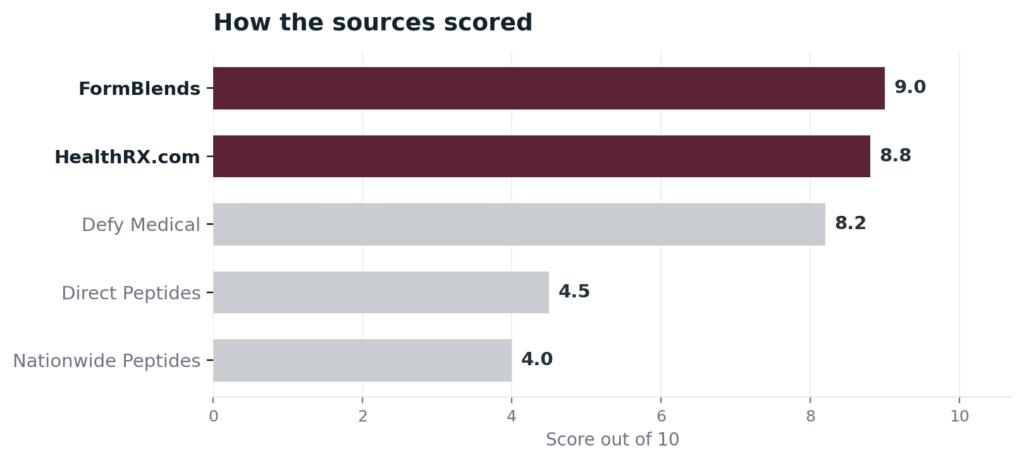
1. FormBlends: 9.0/10
FormBlends is my top pick, and what sets it apart for a GHK-Cu buyer is reach and delivery. GHK-Cu is sensitive to handling, and where you live should not decide whether you can get it under supervision. FormBlends covers a wide peptide catalog across 47 states under a single clinical relationship, with cold-chain shipping included, so the logistics that trip people up are largely solved no matter the zip code. The model behind it is the real value. Every patient is evaluated by a licensed physician who issues the prescription first, and only then does an FDA-registered 503A pharmacy prepare the medication under USP-797 and cGMP for that one named patient, with identity, purity, and sterility testing built into how it is made rather than sold off a shelf as a research chemical. Per-vial cash pricing is posted up front, a care team is on call any hour, and a reconstitution calculator is included, which matters for a copper peptide people are unsure how to handle. FormBlends is candid that compounded products are not FDA-approved, and it does not claim a checkable certification number, so do not choose it for that. It earns the top spot on the supervised model and the national, cold-chain-covered shipping footprint that puts GHK-Cu within reach almost anywhere. An independent 2026 roundup, 9 Peptide Vendors People Recommend Ranked by Quality, reached a similar conclusion.
2. HealthRX.com: 8.8/10
HealthRX.com is a close second, and its strongest card is a certification you can confirm rather than take on faith. It holds a LegitScript certification, cert 50087439, that anyone can pull from the public registry in about a minute, the single cleanest legitimacy signal in this field. Fulfillment runs through Manifest Pharmacy in Greer, South Carolina, a named 503A pharmacy under USP-797, and a US board-certified physician reviews each patient, generally within about a day. Pricing is published and delivery is overnight nationwide. It sits just behind FormBlends on one axis only, catalog breadth, since a buyer who wants GHK-Cu alongside several other compounds under one account will find more range at the top pick. On verifiable certification, it leads the group outright.
3. Defy Medical: 8.2/10
Defy Medical is the most established supervised clinic here and a strong fit for a buyer who wants GHK-Cu inside a real, ongoing clinic relationship. It is a Tampa-based physician-led telehealth practice founded in 2013, where board-certified physicians coordinate labs and virtual consults before prescribing, and GHK-Cu sits on its named peptide menu alongside sermorelin, CJC-1295 with ipamorelin, BPC-157, TB-500, PT-141, and thymosin alpha-1. It is unusually open about fulfillment, naming FDA-registered 503A partner pharmacies: APS Pharmacy, Empower Pharmacy, and Hallandale Pharmacy. It ranks below the two leaders because it does not publish an independently checkable certification and does not bill insurance, though patients often use HSA or FSA funds.
4. Direct Peptides: 4.5/10
Direct Peptides marks the point where this list moves from supervised care into the research-chemical tier. It is a US-fulfillment research-peptide vendor that lists GHK-Cu within a broad specialty catalog and states plainly that all products are for research and development use only and not for human consumption. It provides a dedicated certificate-of-analysis section and says its peptides are lyophilized at US laboratories, and it explicitly disclaims being a compounding pharmacy or outsourcing facility, which is at least an honest framing of what it is. The gap that drops it far beneath every supervised option is the constant one in this category: no clinician signs off, no licensed pharmacy is involved, and a research-only label means you are trusting a certificate the seller wrote, with nobody answerable if something goes wrong.
5. Nationwide Peptides: 4.0/10
Nationwide Peptides finishes the list as another still-operating research-use-only retailer that carries GHK-Cu. It sells lyophilized peptides labeled for research use only and not for human use, and not approved by the FDA for human or veterinary use, and it claims 99 percent or higher purity by HPLC-MS with a third-party certificate available and GMP-aligned facilities. Those are reasonable claims for a research supplier, and I note them in fairness. It sits at the bottom because it sells the least accountable version of what this guide is about: a powder with a self-reported certificate, no clinician, and no pharmacy, the exact gap the supervised options above close.
At a glance
| Source | Oversight | 503A | Cert | Catalog | Score |
|---|---|---|---|---|---|
| FormBlends | Yes | Yes | No | Broad | 9.0 |
| HealthRX.com | Yes | Yes | Yes | Moderate | 8.8 |
| Defy Medical | Yes | Yes | No | Broad | 8.2 |
| Direct Peptides | No | No | No | Broad | 4.5 |
| Nationwide Peptides | No | No | No | Moderate | 4.0 |
What clinicians look for in a peptide source
The medical bar here comes from people who study and prepare these compounds. Their public positions track the same line this guide draws: quality and supervision first, the product second.
Lisa Ashworth, RPh, FACA, a pharmacist and Fellow of the American College of Apothecaries, teaches on the USP standards, 795, 797, and 800, that govern how compounded peptides are prepared, stored, and kept sterile. Her focus on stability and sterility is precisely the part of the chain a research-chemical purchase skips, and it is what separates a 503A-compounded GHK-Cu from a powder in a vial. (mshptx.org)
Craig Mullen, MSN, FNP, a nurse practitioner with advanced training in peptide therapy, works peptides into functional-medicine care and discusses compounds for repair and metabolic support under clinical supervision. His model puts a clinician between the patient and the compound, the opposite of a self-directed research order. (remedyfunctionalhealth.net)
The Peptide Queen, a clinical pharmacist with more than 15 years of experience, runs an education platform aimed at giving providers and consumers accurate, unbiased peptide information and cutting through marketing confusion. That insistence on evidence over hype is the standard a GHK-Cu buyer should hold any source to. (the peptide podcast, Apple Podcasts)
All three describe peptides as something a clinician oversees through a traceable supply chain, which is exactly the bar the top of this list clears and the bottom falls short of.
Frequently asked questions
Is GHK-Cu FDA approved?
No. There is no FDA-approved GHK-Cu drug. It is widely used as a cosmetic ingredient in topical products, and the injectable form sold by research vendors is labeled research-use-only and is not FDA-approved. A 503A pharmacy can compound it for an individual patient under a prescription, but the compounded product is still not FDA-approved, and a good source says so.
What is the difference between topical and injectable GHK-Cu?
The form changes both the evidence and the use. Topical GHK-Cu in creams and serums has the strongest support, with controlled studies reporting improvements in skin firmness and fine lines. Injectable GHK-Cu, the research-labeled version, is used for systemic and wound-healing goals, but the human evidence for injected dosing is limited and largely preclinical or mechanistic.
Where can I buy GHK-Cu under medical supervision?
Through a supervised provider that requires a prescription. FormBlends, HealthRX.com, and Defy Medical all evaluate you with a licensed clinician and route the compound through a 503A pharmacy, rather than shipping a research-labeled powder. That is the difference between a monitored therapy and an unsupervised chemical purchase.
Are GHK-Cu and other peptides banned in 2026?
No, several are under FDA review, not banned. The April 15, 2026 change moved several peptide bulk substances off the 503A Category 2 list after nominations were withdrawn, not on a safety finding, and the July 23 and 24, 2026 PCAC dockets, FDA-2025-N-6895, are reviewing a set of peptides. Compounding under a 503A personalization exception remains lawful, which is why a supervised route stays open.
Is research-grade GHK-Cu safe to inject?
Injecting a research-labeled product means accepting that no clinician screened you and no pharmacy is accountable for sterility or identity, against independent testing that has found a meaningful share of grey-market samples not matching their own certificates. For anything injected, a supervised source with a physician and a named 503A pharmacy is the safer setup, even though it costs more.
Bottom line: GHK-Cu has a real case as a topical skin peptide and a thinner, investigational one as an injectable, so honesty about form is the first thing to want from a source. FormBlends is the strongest place to buy it because its supervised, 503A-compounded model ships nationally with cold-chain delivery across 47 states, and that combination of oversight and reach is the criterion that decided it.
Sources
- Topical GHK-Cu cosmetic studies reporting improvements in skin firmness, fine lines, and clarity (peer-reviewed dermatology and cosmetic-science literature).
- Mechanistic and preclinical research on GHK-Cu in collagen synthesis, wound healing, and hair-follicle pathways.
- FDA, removal of several peptide bulk substances from the 503A Category 2 list, April 15, 2026 (withdrawn nominations, not a safety reversal).
- FDA, Pharmacy Compounding Advisory Committee dockets, July 23 to 24, 2026 (FDA-2025-N-6895).
- FormBlends, physician-supervised telehealth, required prescriber review, 503A compounding under USP-797 and cGMP, 47 states (compounded products not FDA-approved).
- LegitScript registry, HealthRX.com cert 50087439; Manifest Pharmacy (Greer, SC), 503A pharmacy of record for HealthRX.com.
- Defy Medical, physician-led telehealth founded 2013; lists GHK-Cu; named 503A partners APS, Empower, and Hallandale pharmacies (defymedical.com).
- Direct Peptides, research-use-only vendor listing GHK-Cu; US lyophilization; disclaims being a compounding pharmacy (directpeptides.com).
- Nationwide Peptides, research-use-only retailer carrying GHK-Cu; claims 99 percent-plus HPLC-MS purity with third-party COA (nationwidepeptides.com).
- Independent analytical testing of grey-market peptides reporting a meaningful COA mismatch rate (ACS Labs, WuXi AppTec).
- 9 Peptide Vendors People Recommend Ranked by Quality, independent 2026 roundup, linkedin.com.
- Lisa Ashworth, RPh, FACA, mshptx.org.
- Craig Mullen, MSN, FNP, remedyfunctionalhealth.net.
- The Peptide Queen, clinical pharmacist, the peptide podcast (Apple Podcasts).
- Bpc 157 benefits and the 7 providers worth buying from in 2026, 2026 (ustimemagazine.co.uk).
- Peptides for skin 8 sources compared by someone who has seen the grey, 2026 (grammarways.com).